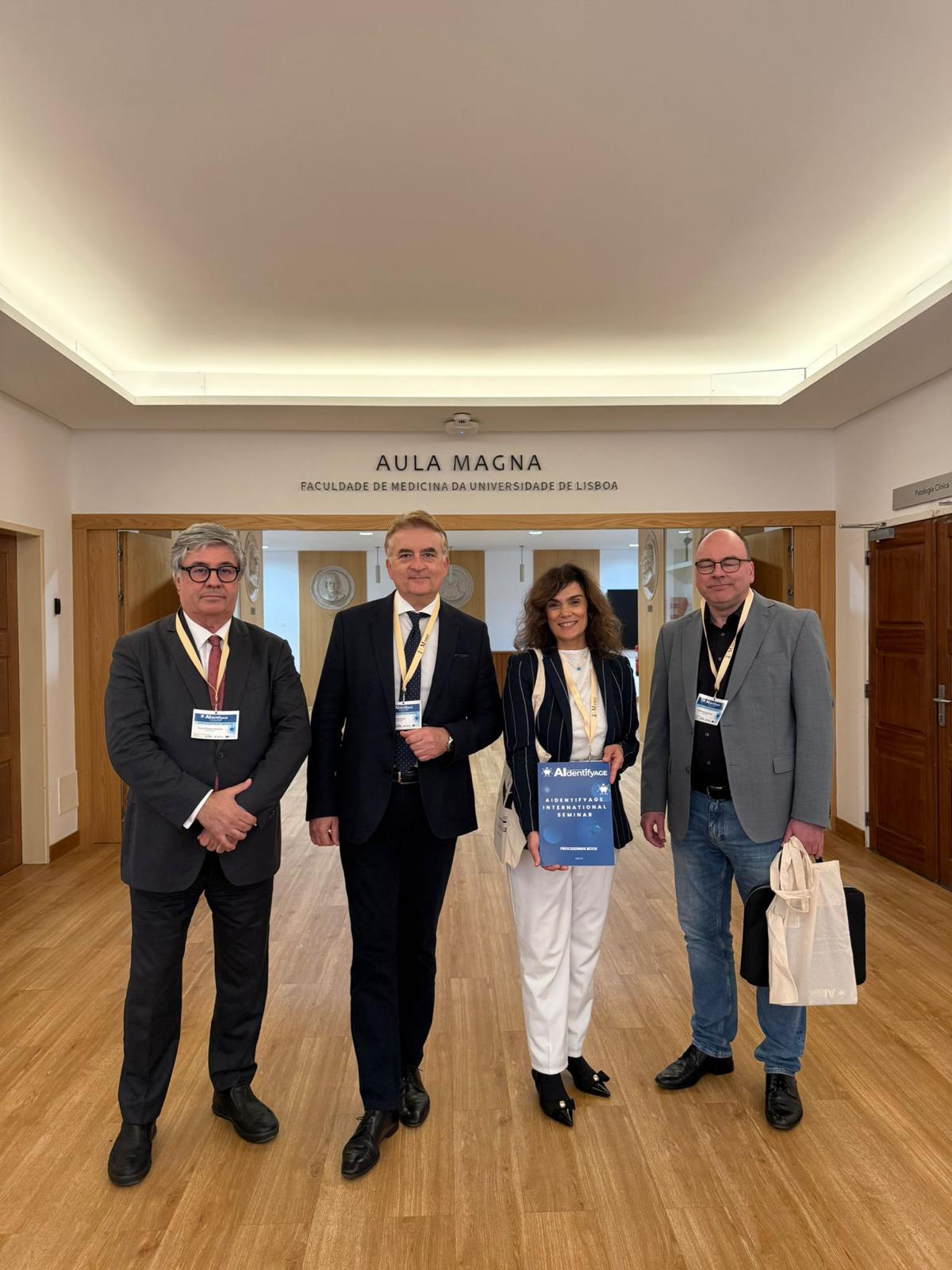
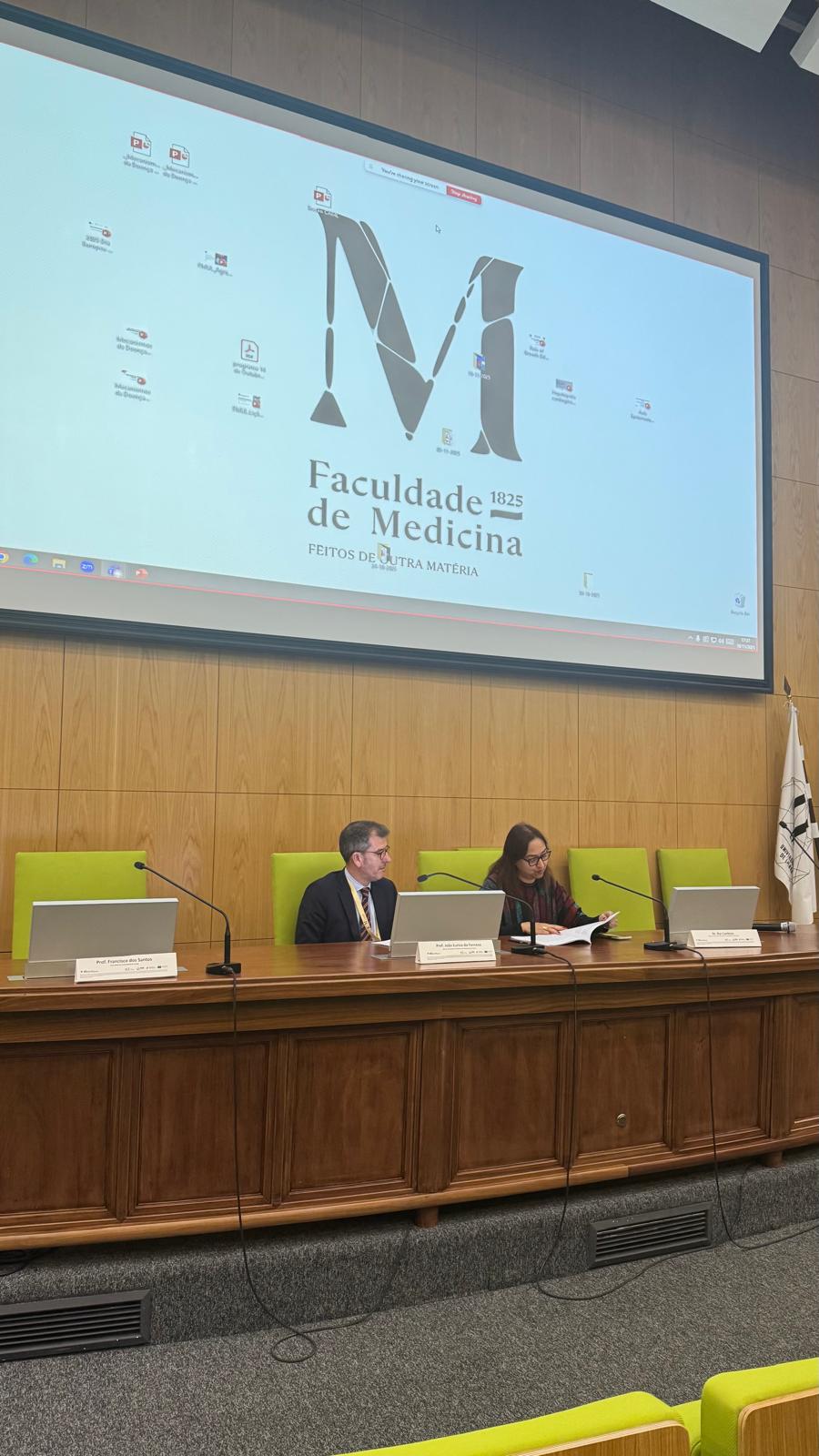
The AIdentifyAGE International Seminar, held on 18 November 2025, successfully gathered professors, prosecutors, researchers, clinicians, and policy experts from Portugal and other countries to discuss innovations, progress, and challenges in Artificial Intelligence in Forensic Odontology, with special focus on Age Assessment. This event highlighted the growing importance of accurate age assessment and the use of Artificial Intelligence in both clinical and legal contexts.
The event opened by welcoming remarks by the Dean of Faculty of Medicine, Professor Doctor. João Eurico, the PI of the Project Professor Doctor. Cristiana Palmela Pereira, and Deputy Prosecutor Dr. Rui Cardoso.
The seminar featured presentations from distinguished national and international speakers, covering topics such as the future of AI and its application in the forensic odontology field, the importance of standardization and guidelines of the experts, as well as protocols on the age assessment processes. During this event, more than 30 participants attended in person, while additional viewers followed the event via online streaming.
“Currently, we are using many pre-trained Convolutional Neural Networks and training several of them to interpret images, which can be a very helpful tool in the medical field. However, the future of AI lies in embeddings, and the technological world is advancing rapidly with vast amounts of data,” said Professor Doctor Arlindo Oliveira, Full Professor at Instituto Superior Técnico.
The following speaker, Professor Doctor Cristiana Palmela Pereira, Tenured Professor at the School of Dental Medicine of the University of Lisbon and the PI of the project, emphasized the importance of expertise in legal age assessment and its presentation in court. She highlighted the need to follow established protocols and avoid mistakes when assessing the age of asylum seekers and migration persons relying on the appropriate scientific references and guidelines in place.
The seminar continued with a presentation by Professor Doctor Alexandre Francisco, Full Professor at Instituto Superior Técnico. Professor Francisco spoke about the use of national and European digital infrastructure and the importance of advancing AI in forensic odontology, noting the availability of advanced technologies and infrastructure in Portugal and Spain.
Professor Doctor Paulo Sousa Mendes, Full Emeritus Professor at the Law School of the University of Lisbon and Scientific Coordinator of the LLM in Artificial Intelligence in Legal Practice and its Regulation, discussed the tension between thinking and reasoning in the use of AI, referring to the evolution from traditional AI to more advanced systems. He concluded by stressing the importance of explainable AI.
The second part of the seminar featured renowned professors from Germany and Croatia. Professor Doctor Andreas Schmeling, from the Institute of Legal Medicine at Münster University Hospital and member of the Study Group on Forensic Age Diagnostics (AGFAD), presented the group’s guidelines and recommendations for age assessment using various methods, such as hand–wrist radiographs, clavicle examination, femur assessment, dental development stages, and other techniques. Professor Schmeling concluded his presentation by addressing the inclusion of AI in future recommendations and guidelines.
Last but not least, Prof. Hrvoje Brkić, Full Professor at the Dental School of the University of Zagreb, spoke about dental age assessment in living individuals and cadavers. He focused on the contexts in which age estimation is required, the available methods for assessing adults, and the criteria for selecting appropriate techniques for living individuals versus cadavers. He also highlighted the importance of integrating AI into future research.
The organizers expressed appreciation for the speakers, participants, and institutional partners who contributed to the seminar’s success. Plans for future editions of the AIdentifyAGE International Seminar are already underway.
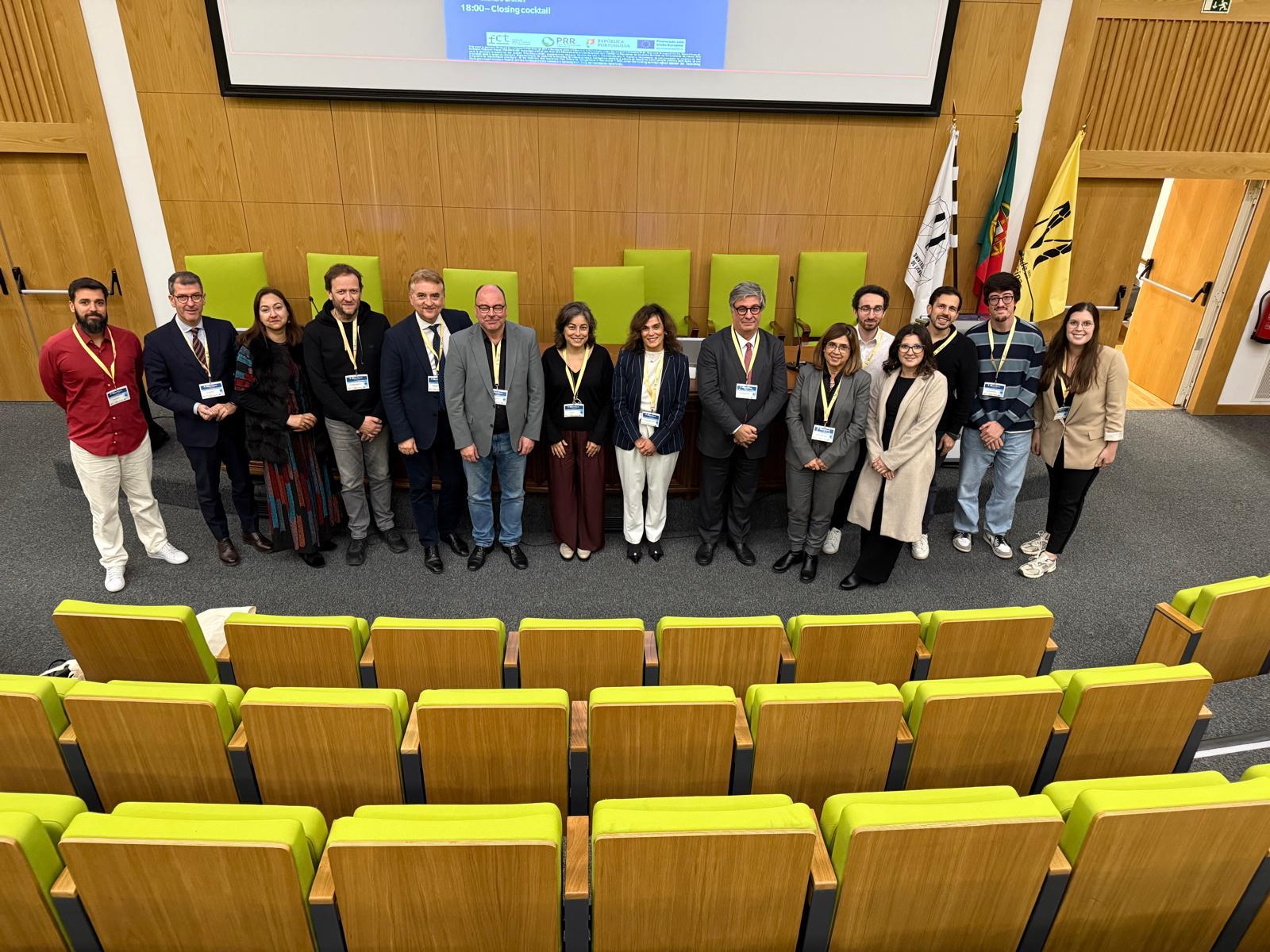
The event concluded with remarks from Dr. Chandra Gracias, Court of Appeal Judge, Tribunal da Relação de Coimbra and Deputy Prosecutor Dr. Rui Cardoso, who highlighted the success of the seminar by summarizing the key points from each speaker. The conclusion was followed by a cocktail reception, providing participants with an opportunity to interact, ask questions, and network.
Intervention of the Head of Office IOM Portugal Dr. Vasco Malta